Friday, March 15, 2013

Reconstruction in New Orleans

Some images for our discussion of Reconstruction. What happened in New Orleans wasn't just interesting, it mattered for the rest of the nation.

H.C. Warmoth, who becomes governor at age 26 in 1868.

P.B.S. Pinchback will become the first "black" governor of Louisiana - for 33 days in 1872-3.


The Mechanics' Institute - Scene of the Riot of 1866 - now roughly where the University Place entrance of the Roosevelt is located.


The U.S. Custom House (now bug museum) as it appears today on Canal Street
The Custom House as it appeared roughly at the time of the Civil War
Eagle Hall - Built during the war - HQ of the Crescent City Democratic Club. Meeting Halls were important in the 19th century urban landscape
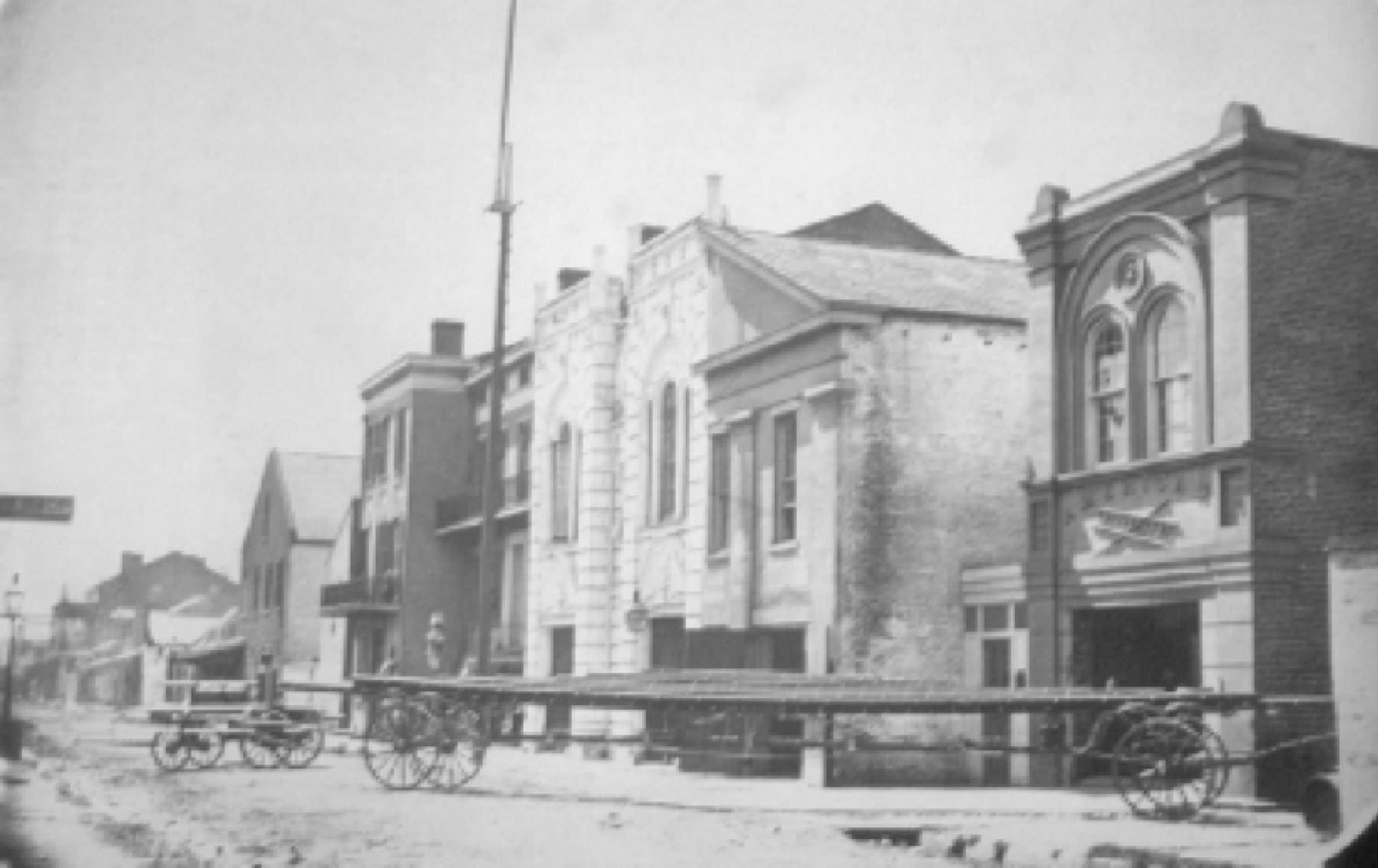
The Washington Artillery Hall (center). Notice fire station on right. Located on Girod Street (no longer in existence)

The levee much like it would have appeared in 1874 - though this picture is from around 1885-1890

Wednesday, March 23, 2011

WWI Memorial


Max bonanno
World civ

G Broussard
MJ Clanders
T Bacon
S.R. Evans
-- Sent from my Palm Pre

Thursday, December 9, 2010

More tips on your paper

1.) Give your paper a title.

2.) Geocode: Give me an address that relates to your topic. Make sure it is a valid street address or a specific location that I can map.

3.) Put your name at the end, like this:

Bob Smith
Loyola University New Orleans

4.) I do not want a bibliography. Before your end notes, please put a "For further reading." This will list one or ideally two books or articles or a link to a website where a reader can find more information about your topic, either generally or specifically. But give me no more than three. This is not unlike Wikipedia.

5.) Images: Include any images you might have separately on a CD that you will provide to me. Include a list of the images with the file names, citing the source of each image. I'll have a student assistant go through these at some point, so be as specific as possible.

6.) Your essay needs to be on the CD in Microsoft Word (doc or docx) format.

7.) I will have a spindle of CDs in the history office tomorrow. Be sure to label the CD with a sharpie. I also want a printed copy.

SOME COMMON MISTAKES:

it is 1920s, not NOT 1920's. They are not possessive.

South is capitalized, as is Civil War.

Here is the order your paper should follow:

Title
Address 

Text of your paper

Name
Loyola University New Orleans

For further reading:

Notes:

(footnotes) 

Wednesday, December 8, 2010

Citation examples for your essay

Here are some citation examples for use in your footnotes. Please place your footnote number at the place where you cite material in the text. Place all footnotes at the end of the document (endnotes). Use this format:

(All the numbers should be superscripts, which I have a problem reproducing in Blogger.)

For a book: 

1 Lawrence Powell, New Masters: Northern Planters during the Civil War and Reconstruction (New Haven, CT: Yale Univ. Press, 1980), 10-23.

Second citation:

2 Powell, New Masters, 244.

For a chapter in a book of essays:

2 Joseph G. Tregle, Jr., "Creoles and Americans," in Creole New Orleans: Race and Americanization, ed. Arnold R. Hirsch and Joseph Logsdon (Baton Rouge: Louisiana State Univ. Press, 1992), 140.

Second citation:

3 Tregle, Jr., "Creoles and Americans," 150.

For an article in a journal:

3 Robert Cinnamond Tucker, "The Life and Public Service of E. John Ellis," Louisiana Historical Quarterly, 29, no. 3, (July 1946): 686.

A letter in an archive collection:

4 Abby Day Slocomb to Col. J. B. Walton, 17 July 1862, Walton-Glenny Papers, Williams Research Center, Historic New Orleans Collection, New Orleans.

U.S. Census (accessed online): Note: every decade's census has a slightly different set of page numbers, roll designations, etc. Just fit them to this form:

5 1860 U.S. Federal Census, roll m653_592, image 499 (all census records were drawn from www. ancestry.com).

A piece of ephemera or photograph in an archive:

6 Photo of Endymion Float, Endymion collection, rare vertical file, Louisiana Room, New Orleans Public Library, New Orleans.

An interview:

7 Interview of Edwin Edwards by Justin Nystrom, 17 September 2001, audio recording in possession of author.

A newspaper: (add as much information as you have for the citation - the older the newspaper, the less you usually have. Headlines and bylines are a relatively modern innovation)

8 Times Picayune, 6 July 1885

8 "Man Bites Dog," John Brown, Times Picayune, 6 July 1992, sec. A, p. 2, col. 4.

Government publication: (again, use as much info as you have)

9 Report on the Use of Tongue Depressors in Left-Handed Doctor's Offices, Department of Health and Human Services (Washington: Government Printing Office, 1991), 21.

if it is unpublished (typescript):

9 "Report on the Liberty Monument," New Orleans City Council (New Orleans: 1987).

An item in a scrapbook:

10 unidentified newspaper clipping, 5 may 1921, scrapbook, box 2, folder 10, Grandma Clampett Papers, Howard-Tilton Memorial Library, Tulane University, New Orleans.

or

10 unidentified and undated newspaper clipping, scrapbook, box 2, folder 10, Grandma Clampett Papers, Howard-Tilton Memorial Library, Tulane University, New Orleans.


For online citations, please list complete URL of website.

Essay 4: The Politics of Race

Essay 4 will challenge you to write about how the politics of race have come to shape New Orleans in the 20th Century. Think about this as broadly as possible and incorporate examples from Hair, Campanella, Mitchell, and Gill.

Because of the short grading turnaround time, please limit your essay to NO MORE than 1200 words. Be concise.

This essay is due Thursday morning at 10:00 AM, along with you Sense of Place Essays. If you have written three essays and are happy with the grade on the two that count, you do not need to write this last essay.

Thursday, December 2, 2010

Tuesday, November 30, 2010

Eracism

Since we're going to be talking a lot about ways in which the city cleaved along racial lines in the 20th century, it might actually make sense to start here, at our destination in the 1990s.

Tuesday, November 16, 2010

A movie my students made

Here is a student film from my First Year Seminar last spring. We'll use it as a jumping off point for discussion.

Beauregard-Keyes House Massacre from Casey Wilkes on Vimeo.


Also, I'm going to show images from www.shorpy.com

Sunday, November 14, 2010

Calendar for the rest of the semester

We have 4 weeks left. Here are the highlights: After turning in the third essay on Tuesday, we will discuss the second-to-last short reading section of Bienville's Dilemma. I suspect a lot of you have not yet started reading Carnival of Fury. I expect a spirited discussion of the first six chapters come Thursday 11/18.  


The final segment of our class is going to focus on twentieth century New Orleans as a product of nineteenth century legacies. 


A VERY IMPORTANT DEADLINE to me is 11/22. I WANT TO KNOW WHERE YOU ARE GOING WITH YOUR RESEARCH BY THEN. What do I mean by a "draft outline?" If you could give me a paragraph explaining the basic idea of your essay. Alternatively, a short outline. Alternative to that, a list of four or six or however main points that you will address in your research essay. I think it is important that you have some plan or confront the fact that you have no plan *yet* before you head out for Thanksgiving. If you aren't going to be here on the 22nd (for some reason) be sure you set up an appointment to see me individually. Whatever you do, don't let that deadline pass.

Week 12: Segregated New Orleans
T 11/16: BD: 174-185: TURN IN TEST 3
R 11/18: Carnival of Fury Chap. 1-6

Week 13
T 11/22: BD: 219-224 / Turn in draft outline of essay / Carnival of Fury Chap. 7-10
R 11/24 – Thanksgiving Break

Week 14
T 11/29: Turn in TEST 4 / BD: 185-193
R 12/2: All on Mardi Gras Day, Chap. 8 (on Blackboard)

Week 15
T 12/7: CNO: Chap. 6 / Turn in rough draft of essay
R 12/9: Lords of Misrule, Chap x (on Blackboard), Receive Test 5 questions

(Final Exam Day): Turn in Test 5 / submit final essay in electronic form.

Thursday, November 4, 2010

Essay 3: Transformations

Your third "petit test" essay will require you to discuss the transformations that the Civil War and Reconstruction unleashed in New Orleans. There is a lot to work with here. Race, politics, culture, economics, demographics, and ethnicity all come to mind.

Thus, your task is a straightforward one: Write an essay that elaborates upon the transformations witnessed in New Orleans between 1860 and 1900. Include as much material as you possibly can within an 1800 word limit. This will again be an exercise in concise writing. Be precise with your words. No fluff allowed!

Due: Thursday, 2/11 in class.

Wednesday, October 20, 2010

On the Eve of War

Today we are going to look at the turbulent 1850s in New Orleans. Politics of this decade definitely distinguish the city from the rest of the South of the same period. Some of the issues like Know-Nothingism (albeit a uniquely New Orleans brand of Know-Nothingism) were a lot more like one might find in a northern city.

Many other strings tied the Crescent City to the North, not the least of which was the issue of protectionism and the politics of sugar. We'll discuss that.

Nevertheless, New Orleans was the nerve center of slave trading in the West. It was also a major cotton port. These factors weighed heavily in loyalties in the city.

The election of November, 1860 delivered one portrait of Unionism in New Orleans. The secession convention of January 1861 portrayed something altogether different. We'll look at how that came to pass.

Mobilization for war began immediately, but had New Orleans Confederates had any idea what was at stake, they may have acted differently. Some topics for consideration: industry, banking, blockades, recruiting, black Confederates, and city defenses.

Some key locations: Fort Jackson & St Philip. Fort Macomb & Fort Pike. 


View Geographic Places of New Orleans in a larger map

Thursday, October 14, 2010

Petit Test 2

Questions for Petit Test 2 – A History of New Orleans: Nystrom

Since the last essay, the main focus of our course has been about the growth of antebellum New Orleans, particularly with regard to culture, ethnicity, and politics. Arguably, the debate over the meaning and cultural value of the term “Creole” can serve as a metaphor for the themes that we have covered. Your job will be to write an essay telling the history of antebellum New Orleans (broadly construed from the time of the Louisiana Purchase in 1803 to 1860) using “Creoles vs. Americans (and others)” as a window onto the key cultural, economic, demographic, and political developments in the city during this time period. Be sure to incorporate elements from your readings, lectures, class discussion, and film in your essay.

***

Some questions to consider in constructing your argument:

Does the notion of “Creole” reflect reality or is it a fabrication? Can it be both? If so, where do we draw the line? Does this line move over time?

To what extent has the “non-Creole,” or “other” defined “Creole?”

To what extent did the notion of “Creole” color all aspects of civic, political, and economic life in antebellum New Orleans?

If “Creole” is an overblown distinction in understanding antebellum New Orleans, how might we recast our narrative of the period’s most dominant themes?

***

Your first essays were an exercise in straightforward argument. Here you will need to take things to a new level by marshaling solid evidence in support of a nuanced thesis. You have much greater latitude in this assignment in that you will need to decide how much agency you afford to the notion of “Creole” in that it defines the antebellum city.

Word limit is set at 1800. This means that you will need to craft a tight essay with little to no fluff.

Essays are due at the beginning of class on Thursday, October 21, 2010

Tuesday, October 12, 2010

Jezebel

In addition to discussing our reading, I am laying a surprise on you today. We're going to watch Jezebel in class. Half today, half on Thursday. But we're going to be watching it less as a theatrical production and more as an analysis of a popular interpretation of some of the historical themes we've encountered. It's relatively short (104 minutes) so we'll be able to have 50 minutes of viewing today and roughly 50 on Thursday with about 20 extra minutes for discussion. But we'll be discussing even as the movie plays.

If the projector works.

Also, some have asked about my film on the Deutsches Haus. You can see it here:

The Last Oktoberfest from Justin Nystrom on Vimeo.

Thursday, October 7, 2010

Waterways and Ethnicity

First, an 1845 map of New Orleans:


Then, let's take another look at our ongoing Google Map and consider the effects of artificial waterways on the growth and settlement of the city.


View Geographic Places of New Orleans in a larger map

We are also going to have a lot of material about ethnicity today, including the contentious term "creole," a look at the Irish, Germans, French, and others who made the city a polyglot metropolis in the antebellum period.

Lastly, we will look at the rise and importance to New Orleans of plantation agriculture, the business of slavery, and the business of supplying and transhipping the goods of the Mississippi Valley.

Tuesday, October 5, 2010

Revised Schedule for Course


REVISED REMAINDER OF THE SCHEDULE: Nystrom HIST 240 (issue date 10/5/10)

Week 6: The American Era Dawns
T 10/5: BD: 260-262. CNO: Part II Introduction, Chap. 3
R 10/7: BD: 131-135, 161-174, 200-203, 262-270

NO RESEARCH FIELD TRIP THIS WEEKEND.

Week 7: Creolization and Ethnicity
T 10/12: CNO: Chap. 4
R 10/14: Due date for annotated bibliography for essay: Receive TEST 2 questions.

NO RESEARCH FIELD TRIP on WEEKEND.

Week 8: The War Cometh
T 10/19 – Fall Break
R 10/20: TURN IN TEST 2: Lecture on CW in New Orleans / Watch Jezebel (streamed online)

Tentative: 10/22 Civil War and Reconstruction walking tour

Week 9: War and Reconstruction
T 10/26: CNO: Part III Introduction + Chap. 5
R 10/28: Reconstruction in New Orleans

Week 10: Unanswered Questions of the Late 19th Century
T 11/2: Wrapping up Reconstruction
R 11/4:  New Orleans after the Civil War: Chap. 8 & 9 (on Blackboard)/ Receive questions for Test 3

Week 11: Turn-of-the-century turmoil
T 11/9: Turn in primary research report for essay
R 11/11: ,

Week 12: Segregated New Orleans
T 11/16: BD: 174-185: TURN IN TEST 3
R 11/18: Carnival of Fury Chap. 1-6

Week 13
T 11/22: BD: 219-224 / Turn in draft outline of essay / Carnival of Fury Chap. 7-10
R 11/24 – Thanksgiving Break

Week 14
T 11/29: Turn in TEST 4 / BD: 185-193
R 12/2: All on Mardi Gras Day, Chap. 8 (on Blackboard)

Week 15
T 12/7: CNO: Chap. 6 / Turn in rough draft of essay
R 12/9: Lords of Misrule, Chap x (on Blackboard), Receive Test 5 questions

(Final Exam Day): Turn in Test 5 / submit final essay in electronic form.

Researching Property

We have a bunch on our agenda today. In addition to discussing our readings, going over our new schedule, getting back your first essays, and a few other things, I am going to show you how to stalk people.

Okay, not actually "stalk" per se. But you will learn how to research a property back to the original owners, finding all subsequent owners along the way.

Once again, we will be using aids from the New Orleans Public Library's Louisiana Division.

And also, the Orleans Parish Assessor / Conveyance Office.

Monday, September 27, 2010

The New Orleans Public Library and research links

Here is a good link to start doing more investigation into your research from the New Orleans Public Library.

A lot has been written about New Orleans in popular and scholarly journals. Databases can be a great way to find things, but sometimes it pays to search the index of publications that are among the most likely to contain useful material. Here are a few you should consider examining more closely:

Louisiana History
The Louisiana Historical Quarterly (became Louisiana History in the 1980s) (both LH and LHQ are in JSTOR)
Cultural Vistas (published by the Louisiana Endowment for the Humanities)
The Historic New Orleans Quarterly

And, of course, you should search the catalog of the Historic New Orleans Collection (called MINT) for items related to your topic.

The Louisiana State Museum has a lot of useful databases to search, including maps and images. Go to their site and investigate under the "Search and Reference" tab.

Pix from our trip to Spanish Fort and Pitot House

Happy students at Spanish Fort

The oldest fire hydrant!

At Pitot House (nice yawn!)